


 Pristupačnost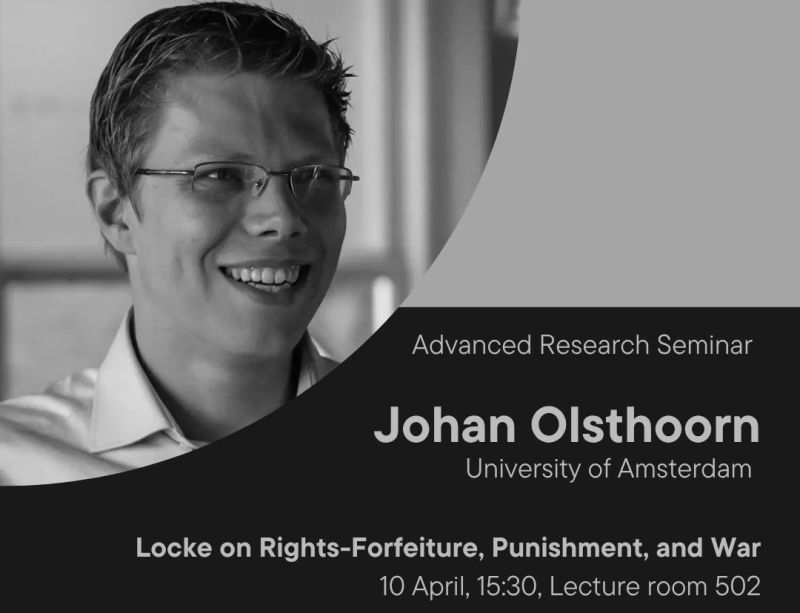
The upcoming edition of the Advanced Research Seminar will take place on 10 April at 15:30 (Lecture room 502).
Locke on Rights-Forfeiture, Punishment, and War
One major contribution of A. John Simmons’ acclaimed The Lockean Theory of Rights (1992) is its development of a rights-forfeiture theory of punishment. Following Locke, Simmons argues that the individual natural right to punish is a special right, arising from criminal rights-forfeiture. By using unjust force, offenders lose the right not to be subjected to proportionate punishment vis-à-vis everyone. This chapter argues against interpreting Locke’s theory of rights-forfeiture narrowly through the lens of punishment. Much of the work in justifying harm to offenders, I contend, is done by natural rights of self-defense – rather than of punishment.
Invoking liability to defensive harm allows me to resolve two interpretive puzzles Simmons faces. Locke endorses (i) a natural right to kill thieves (II.18, II.207); and (ii) holds that rights-forfeiture can give rise to “Absolute, Arbitrary Power” over the offender, “to take away his Life, whenever he pleases” (II.172; II.182). Both claims jar with Locke’s insistence that punishment must be proportionate to the crime: natural rights to punish cannot ever justify “Absolute or Arbitrary Power” (II.8). Locke’s position, I contend, is coherent: for unjust aggressors may rightly be killed and enslaved on defensive (rather than punitive) grounds outside civil society. Significantly, proportionality is not a condition of justified self-defense in Locke. Anyone who launches a state of war by engaging in unjust aggression loses their rights wholesale: having “quitted reason” and adopted the maxim of beasts, unjust aggressors threaten the safety and security of all (II.172). Aggressors remain liable to be defensively killed by all until they repentantly offer peace and reconciliation (II.20).
My reconstruction of the logical connections between what Locke calls “rights of war” and “the state of war” on the one hand, and his rights-forfeiture theories of self-defense and punishment on the other, lead me to propose several major revisions to Simmons’s interpretation of Locke. One upshot of my analysis is that over-punishment is less of an issue in the state of nature than Simmons believes. Another is that rights-forfeiture takes a directed form in Locke: it explains when and why the infliction of defensive or punitive force is not unjust to offenders (rather than overall justifying such force).
Johan Olsthoorn is Associate Professor of Political Theory at the University of Amsterdam, the Netherlands. The author of Hobbes on Justice (Oxford, 2024), he has published extensively on Locke’s moral, legal, and political philosophy.


